CO2 Laser Wavelength Explained: What 10,600 nm Means for Equipment Buyers
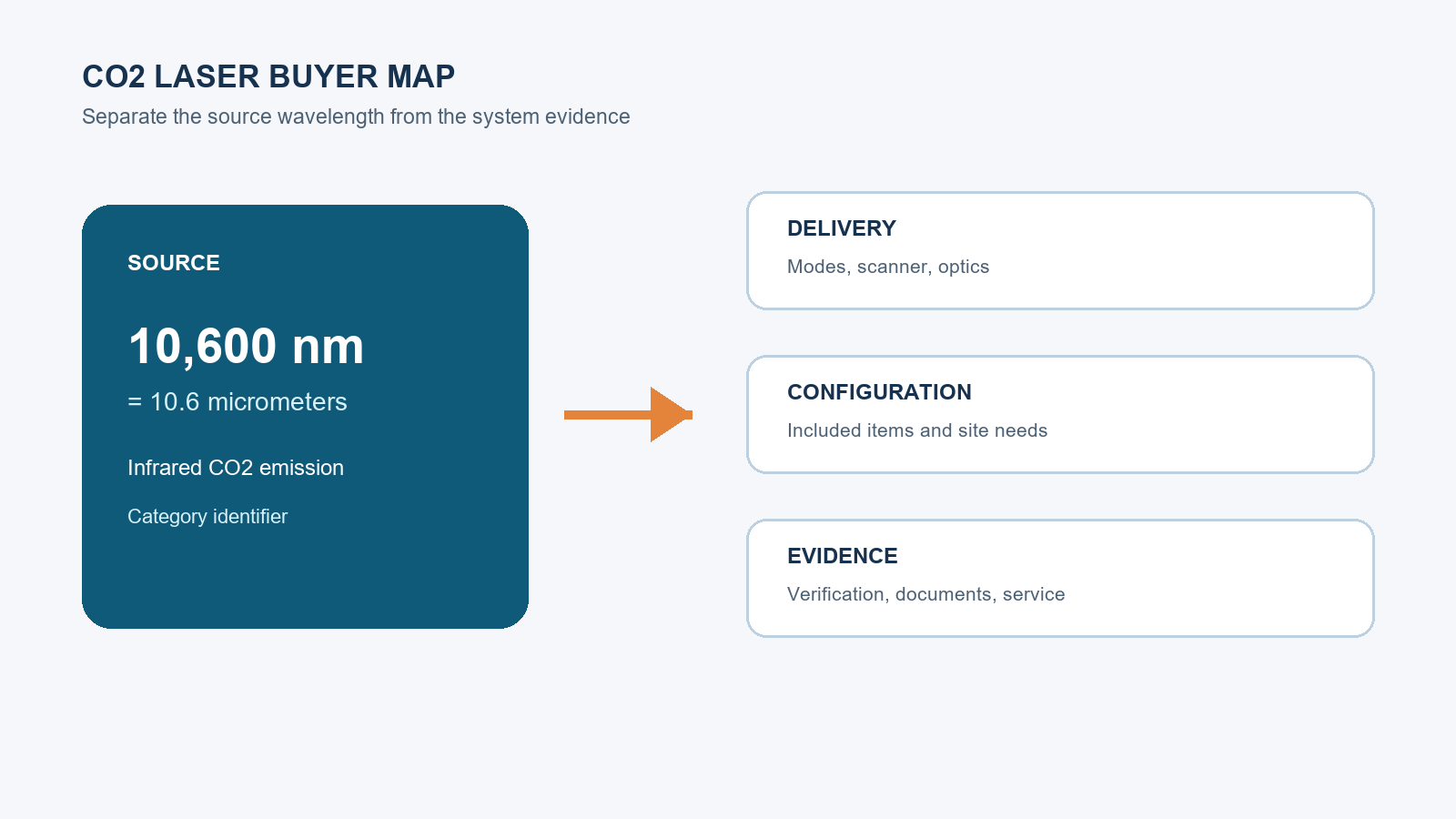
The CO2 laser wavelength most equipment buyers see is 10,600 nm, or 10.6 micrometers. That number identifies the emitted infrared light, but it does not tell a clinic or distributor how the system delivers the beam, how its output is verified, which accessories are supplied, or which documents apply in the destination market.
This distinction keeps a technical comparison useful. Start with wavelength to confirm the laser category. Then compare delivery mode, output controls, scanning, optics, cooling, supplied components, documentation, and service scope as separate fields.
CO2 laser wavelength in one sentence
A CO2 laser commonly emits at 10,600 nm, which is the same as 10.6 micrometers. The National Institute of Standards and Technology lists CO2 laser calibration capability at 10.6 micrometers, giving buyers an authoritative reference for the wavelength notation.
The practical buyer answer is therefore simple: 10,600 nm identifies the source wavelength, not the complete equipment configuration. A quotation that states only “CO2 laser, 10,600 nm” still leaves most operational questions unanswered.
Searchers also ask what wavelength is a CO2 laser because supplier pages may switch between nanometers and micrometers. Divide nanometers by 1,000 to convert the units: 10,600 nm equals 10.6 micrometers. The two figures do not describe different laser types.
Why 10,600 nm defines the source but not the result
A 10,600 nm CO2 laser emits light that is strongly absorbed by water-containing tissue. A peer-reviewed review of laser resurfacing identifies 10,600 nm as the CO2 emission wavelength and explains its water absorption. That interaction helps explain why CO2 systems are described as ablative equipment, but it is not a treatment guarantee and does not establish a safe or suitable setting for any person.
For procurement, wavelength has three limited jobs:
- confirm the claimed laser category;
- establish which optical components and measurement methods must work at that wavelength; and
- provide a common starting point for comparing quoted systems.
It does not prove beam quality, pulse structure, delivered energy, scan uniformity, cooling performance, software behavior, safety controls, clinical outcome, or market authorization. Those features need their own evidence. The safest comparison keeps “10,600 nm” in one field and refuses to use it as shorthand for the rest of the machine.
Separate wavelength from delivery mode
The same wavelength can be delivered in different ways. Ask the supplier to name each quoted mode and identify the handpiece, control range, and documentation that belong to it.
Full-field and focused delivery
Full-field delivery exposes a continuous area rather than leaving untreated spaces between small treatment zones. A focused handpiece may concentrate the beam for a different task. These descriptions concern beam delivery and accessories; neither follows automatically from the wavelength line.
Buyers should ask whether the quoted system includes the relevant handpiece, which operating modes are available in the offered configuration, and how each mode is identified in the user documentation. Do not infer a cutting mode from a product category or a photograph.
Fractional delivery
A fractional CO2 laser distributes energy into separated treatment zones. The wavelength remains 10,600 nm, while the fractional pattern depends on the scanner, controls, spot geometry, spacing, and selected settings. A buyer therefore needs the scan range and pattern controls, not merely the word “fractional.”
The distinction also prevents a common comparison error. Two systems can share a wavelength and still provide different scan areas, handpieces, interfaces, or operating modes. The wavelength field makes them members of the same source category; it does not make their working packages equivalent.
Scanning is a control function
A scanner moves or positions the beam according to a defined pattern. The supplier should state the maximum scan area, available shapes or patterns, adjustment method, and which scanner is included. Request a live demonstration with the quoted configuration when scan behavior is material to the purchase.
Treat a promotional image as orientation, not measurement evidence. The written specification and acceptance record should identify the delivered scanner and applicable range.
Compare the equipment beyond wavelength
A useful CO2 laser equipment buyer checklist separates what is measured, what is included, and what must be confirmed after delivery.
| Comparison field | What to record | Evidence to request |
|---|---|---|
| Laser source | Stated wavelength and source type | Current model specification |
| Output | Power range, selectable modes, and display units | Specification plus verification method |
| Delivery | Included handpieces and applicable modes | Itemized configuration and manual |
| Scanner | Maximum scan area and adjustable pattern fields | Scanner specification and demonstration |
| Optics | Included lenses, tips, mirrors, or articulated delivery components | Packing list and labeled images |
| Cooling and site needs | Cooling arrangement, electrical input, environmental limits | Installation and user instructions |
| Software | Version, language, saved settings, access roles, and update route | Version record and support scope |
| Safety information | Labels, interlocks, eyewear, warnings, and operating limits supplied with the exact model | User and servicing information |
| Market documents | Model identity and destination-specific files available for review | Document list, not a generic badge |
| Service | Operator tasks, authorized service tasks, parts route, and escalation contact | Written support process |
For the United States, the FDA describes medical lasers as medical devices and radiation-emitting electronic products. Its medical laser overview is a useful federal starting point, but it does not replace review of the exact device, intended use, state requirements, facility rules, or professional scope. Buyers in other markets need the relevant national and local sources.
The comparison should also distinguish a displayed value from a verified delivered value. A control screen may show power, time, spacing, or pattern selections, but the buyer still needs to know what the display represents, how the equipment is checked, and what acceptance evidence is supplied. Ask the supplier to explain the measurement point and method in plain language. If the answer depends on an optional meter, test accessory, or service procedure, put that item in the configuration sheet rather than assuming it is included.
Clinics and distributors will use the same facts differently. A clinic may prioritize an interface its trained team can operate consistently, a handpiece set that fits the planned service scope, and an escalation route that limits appointment disruption. A distributor must also decide whether it can reproduce the configuration across orders, train customers from the supplied documents, identify parts correctly, and support the scanner or delivery components in its territory. One technical table can serve both buyers, but the decision column should reflect the actual operating role.
Put published MQLASER specifications in the right columns
MQLASER publishes two fractional CO2 product references that can anchor a written comparison. DEPPLUS is described as a stationary fractional CO2 system, while DIATERMOLOGIE is described as a portable fractional CO2 system. Published reference values for both include 10,600 nm, a 15-70 W range, and a maximum 20 x 20 mm scan scope.
Those shared figures belong in the wavelength, output, and scanner columns. They do not establish that the two systems have identical internal components, included accessories, cooling arrangements, software, transport requirements, or service needs. The word “portable” also does not tell a buyer how the unit should be moved or installed.
Use the fractional CO2 laser product line to identify the model you want to discuss, then request a current, model-specific configuration. Keep optional items and unresolved fields outside the standard package until the quotation confirms them in writing.
Turn the specification into a buying decision
Send the same questions to every shortlisted supplier:
- What exact model, source wavelength, power range, modes, scanner, handpieces, optics, foot controls, eyewear, and accessories are included?
- Which photographed or demonstrated items are optional?
- How is output checked at the source and, where relevant, through the delivery system?
- What installation, electrical, cooling, ventilation, room, and environmental conditions apply?
- Which checks may the operator perform, and which tasks require authorized service?
- What user, servicing, training, labeling, and destination-market documents accompany this serial-numbered unit?
- How are software versions, updates, faults, parts, and service actions recorded?
- What acceptance checks will be completed before the buyer signs for the equipment?
The decision rule is straightforward. First confirm the CO2 laser wavelength. Next require evidence for the delivery package and the operating context. Finally, leave a material field open rather than treating silence as equivalence. A clinic can then judge fit for its team and facility, while a distributor can judge whether it can describe, import, hand over, and support the same configuration consistently.
When the checklist is complete, request a written CO2 laser configuration that distinguishes included items, options, documents, and unresolved points.
FAQ
Q: Is 10.6 micrometers the same as 10,600 nm?
A: Yes. One micrometer equals 1,000 nanometers, so both notations describe the same wavelength.
Q: Does every fractional CO2 laser use the same scanner?
A: No. “Fractional” describes the delivery concept, not one universal scanner. Compare the quoted scan area, available patterns, controls, included handpiece, and verification method for the exact model.
Q: Can wavelength confirm that a system is cleared for my market?
A: No. Wavelength identifies a technical characteristic. Market status depends on the exact product identity, intended use, documentation, and rules that apply in the destination.
Q: Should a distributor compare stationary and portable systems by weight alone?
A: No. Compare packing, handling, installation, cooling, electrical needs, accessories, demonstration use, and support logistics. Confirm current dimensions and weight in the signed specification rather than relying on a category label.