Nd:YAG Laser Machine Buying Guide: One Crystal, Two Modes
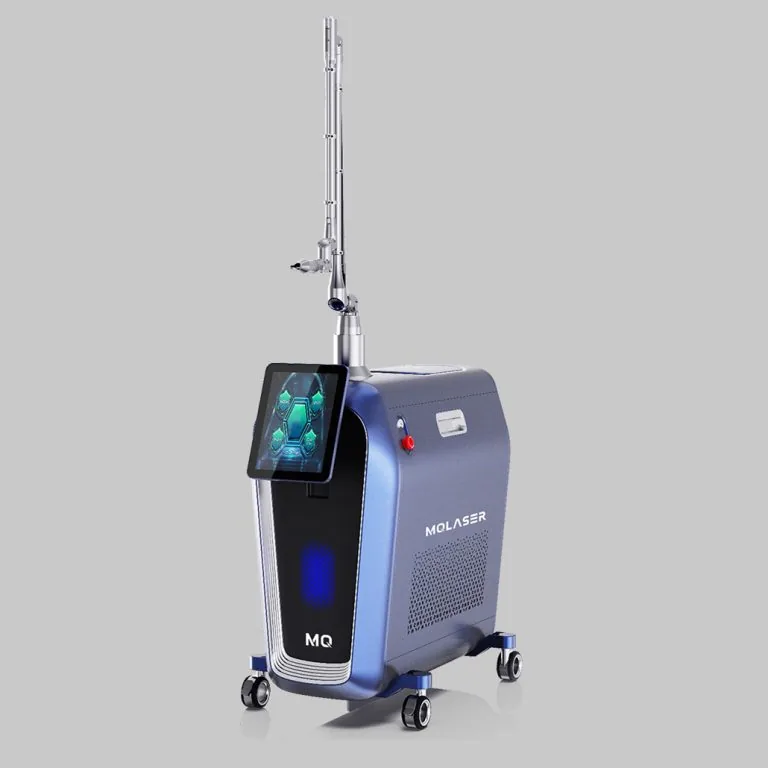
Type "nd yag laser machine" into a search box and the results page is a wall of product listings — every vendor selling something called Nd:YAG, almost none explaining what the phrase commits you to when you buy it. Here is the uncomfortable starting point: Nd:YAG is not a treatment, not a mode, and not even really one wavelength. It is a crystal — neodymium-doped yttrium aluminum garnet — that a laser engineer can build into machines that behave in radically different ways. Two listings that both say Nd:YAG can differ more than a sports car and a freight train differ while sharing "engine." This guide exists so that when you compare two Nd:YAG quotes, you are comparing the crystal's configuration rather than the crystal's name.
One Crystal, Several Beams
The Nd:YAG gain medium produces its fundamental laser light at 1064 nm, in the near-infrared — invisible in operation, which is itself a reason the platform demands documented safety practice rather than informal habits. That 1064 nm beam is the baseline every Nd:YAG machine shares. From there, engineering diverges. Pass part of that beam through a frequency-doubling crystal (potassium titanyl phosphate, usually abbreviated KTP) and you get 532 nm — green light, absorbed differently by pigment and vessels. Manufacturers publish other conversion or dye-style options too: MQLASER's DEPELITE page, for example, lists 1064 and 532 nm as published wavelengths and describes 755, 1320, 585 and 650 nm as optional customization wavelengths — a phrasing that means those beams exist only if your quoted configuration says so, in writing.
So the first question to any Nd:YAG vendor is deceptively simple: which beams does the machine I am buying actually emit, and which appear only in the catalog? A machine whose specification table prints 1064/532 nm delivers both. A machine advertising "multi-wavelength capability" with one table value is selling a future conversation. Those are different products at different prices, and the listing text rarely distinguishes them.
The Mode Switch Changes the Purchase More Than the Crystal
If wavelengths decide what light exists, operating mode decides what that light does on contact. Nd:YAG platforms are broadly built in two mode families, and confusing them is the single most common sourcing error in this category.
A Q-switched Nd:YAG packs its pulse into nanoseconds by mechanically or electro-optically interrupting the beam path — energy squeezed short, which produces the high peak power that shatters pigment particles. A long-pulsed Nd:YAG stretches the same crystal's output into millisecond-range pulses: lower peak power, sustained thermal effect — a fundamentally different job on tissue even though the wavelength column looks identical. And sitting beside both, the picosecond class pushes pulse duration below nanoseconds entirely; MQLASER's DEPELITE, published at 350 ps on its 1064/532 platform, is an example of that class built on this same crystal family.
The procurement consequence: two quotes both headed "Nd:YAG" can be a pigment-shattering device, a thermal device, and a picosecond device respectively. They are not variants; they are different machines that happen to share a crystal. Any comparison sheet that puts them in one row because the wavelength column matches has already made the wrong purchase. If your question is specifically how to choose between picosecond and Q-switched technology for tattoo work, the pico versus Q-switch buying guide takes that decision apart; this article sits one level below it, at the platform.
The Fields That Make Two Quotes Comparable
Once mode and beams are fixed, the remaining spec fields translate physics into workload. For a published reference point, DEPELITE's page states frequency 1–10 Hz, energy 20–3,000 mJ, spot size 2–10 mm, input 110/220 V at 50/60 Hz, and 1,800 W power. Each field has a buying reading. Frequency bounds how many pulses a minute the machine sustains, which caps session tempo. The energy range tells you how wide an operating envelope the supplier is willing to certify on paper. Spot size, paired with energy, is half of the fluence equation — the J/cm² figure vendors quote at you is computed from exactly these two numbers, and a machine can be made to "win" a fluence comparison purely by choosing a smaller measured spot. That is why any fluence claim deserves the question: energy over what spot area, measured how?
Repeat-rate ceilings deserve the same treatment as on diode platforms; the arithmetic logic in the diode specification reading guide transfers line for line. Where an Nd:YAG differs is that pulse width joins the comparison as a first-class field — it is the mode's fingerprint, and a vendor who cannot state it (in nanoseconds, or picoseconds, or milliseconds) has not told you which machine they are selling.
Application Claims Versus Wavelength Facts
Vendor listings love application lists, and Nd:YAG collects more of them than any other platform, because the crystal genuinely spans a wide territory: 1064 nm's deep penetration and pigment behavior, 532 nm's superficial pigment and vascular uses, long-pulsed thermal work, and — as optional configurations — the other wavelengths above. A clinic reading such a list can reasonably conclude the platform is versatile. What the list must not be allowed to do is smuggle in per-indication promises. Hair-removal use is one example: MQLASER's Alexandrite & Nd:YAG line publishes a long-pulse 1064 nm beam paired with 755 nm in one system, and its published package is a hair-removal configuration rather than a general pigment or vascular platform.
The buying discipline is to keep two columns separate. Column one, facts about the machine: published beams, mode, pulse width, energy, spot, frequency — the configuration sheet. Column two, statements about outcomes: what any treatment will achieve, for whom, at what settings. Column two belongs to clinical literature, licensed operators, and the training program attached to the machine — not to the sales page. On this site's own product pages, DEPELITE is framed as a professional pigment and tattoo-removal evaluation platform with published fields, and the site's position is that indications sit with the operator's training and protocols. A supplier who keeps that boundary in their own documents is usually the one whose technical answers survive audit. For where Nd:YAG machines sit in the market — new professional units versus marketplace and consumer classes — the equipment-class breakdown places the platform in the professional tier with its service and documentation obligations.
A Supplier Verification List Before You Shortlist
Run every Nd:YAG quote through five verification asks; the machine earns its shortlist place by how many it passes in writing.
| Verification | Ask for | Failure mode it prevents |
|---|---|---|
| Beam list in the spec table | 1064/532 nm (and any option wavelengths) printed for the quoted unit | Buying a catalog option you never receive |
| Mode and pulse width stated | Q-switched / long-pulsed / picosecond named, with pulse duration in units | Comparing a thermal machine to a pigment machine |
| Fluence basis disclosed | Energy range plus spot sizes used to compute any J/cm² claim | A spec-sheet that wins on paper arithmetic only |
| Calibration and service route | Named contact, calibration proof, parts sourcing, escalation path | A down week becoming a down month |
| Training package | Operator training covering the machine's modes, test procedure documentation | Capability left on the table, or used unsafely |
If a vendor answers all five in documents, the Nd:YAG question becomes what it should have been from the start: a configuration decision. MQLASER publishes its Nd:YAG-family platform — DEPELITE, at 350 ps on 1064/532 nm — on the picosecond and Q-switch product line, with the values quoted above on the model page, and inquiries through the contact page should carry this verification list with them. A supplier who answers five verification asks line by line has just shown you their post-sale behavior before you have paid.
FAQ
Q: Is an Nd:YAG laser the same thing as a Q-switched laser? No, and the distinction is the whole buying lesson. Nd:YAG names the gain crystal; Q-switched names a method of delivering its light in extremely short, high-peak pulses. A Q-switched machine is Nd:YAG in mode, but the crystal also ships inside long-pulsed and picosecond machines that do different jobs. Ask for mode and pulse width, and the category stops being ambiguous.
Q: What does "dual wavelength" actually mean on a spec sheet? On an Nd:YAG machine it normally means the 1064 nm fundamental beam plus a 532 nm frequency-doubled beam produced through a KTP crystal inside the handpiece path. Verify that both values appear in the quoted configuration's table, and verify whether switching is optical (a filter the operator selects) or claimed through customization. "Dual wavelength" printed above a one-value table is marketing grammar, not engineering.
Q: Can one Nd:YAG machine handle both tattoo removal and vascular work? The platform spans both territories in principle, but which it handles depends on the configuration you buy — beams, mode, pulse options — and on operator training for each indication. A Q-switched 1064/532 pigment machine and a long-pulsed thermal machine with matching optics are both "Nd:YAG," and neither automatically does the other's job. Configuration plus training decides, listing text does not.
Q: How do I compare fluence figures between two Nd:YAG machines? Rebuild the number yourself: fluence in J/cm² is pulse energy divided by beam area, so take each machine's published energy range and spot size — DEPELITE's page, for instance, publishes 20–3,000 mJ and 2–10 mm — and compute the range at the same measured spot diameter. Two machines quoting the same headline J/cm² often disagree once both are normalized to one spot size, and that normalization is five minutes of arithmetic that ends most spec-sheet arguments.