Laser Hair Removal Machine Cost: A 12-Month Comparison Guide for Clinics and Distributors
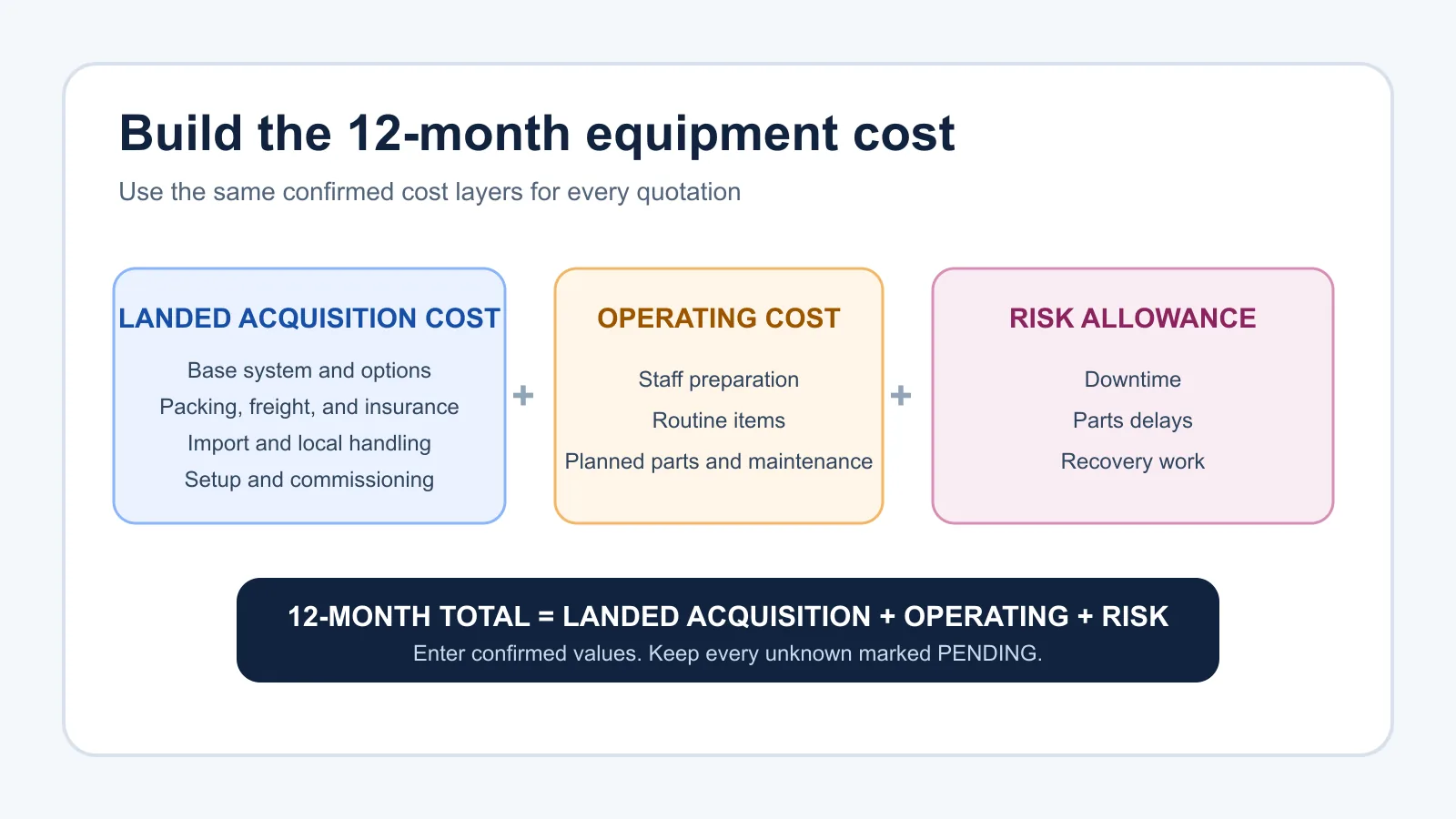
The laser hair removal machine cost on a supplier quotation is only the first part of the buying decision. A clinic or distributor also needs to price the selected configuration, freight and import costs, setup, staff preparation, routine operating items, replacement parts, and the financial effect of downtime. Because those inputs vary by model and market, a credible budget should be built from a written configuration and a 12-month total-cost worksheet rather than a generic price found online.
This guide shows how to build a 12-month laser hair removal machine cost worksheet and compare quotations on the same basis. There is no defensible single figure without a confirmed model, included-item list, delivery term, and destination-market requirements. The result is a laser hair removal machine budget that can be checked against the clinic's real operating plan.
Why the machine price is not the full equipment cost
Two quotations can show the same equipment category and still cover different purchases. One may include several spot sizes, a treatment handpiece, operator materials, remote setup support, and export packing. Another may list only the base unit. Comparing the headline totals without normalizing those inclusions makes the cheaper line item look better even when it creates more spending after delivery.
Start by separating the budget into three layers. The acquisition layer covers the machine, selected handpieces, accessories, packing, freight, insurance, customs, and any installation or commissioning charge. The operating layer covers consumables where applicable, utilities, routine care, replacement parts, staff time, and local service arrangements. The risk layer covers the cost of cancelled appointments, slow parts delivery, retraining, or a configuration that cannot support the planned service menu.
This structure also helps distributors. A landed unit cost is useful, but it does not show the cost of preparing sales material, training resellers, holding spare parts, or handling support questions across several clinic customers. Those items need their own budget lines.
Which configuration choices change professional laser hair removal machine cost
A professional laser hair removal machine cost comparison should begin with the exact system offered, not a broad label such as “diode laser.” Ask each supplier to complete the same configuration sheet and attach it to the quotation.
Wavelength package and laser source
The wavelength package shapes the machine specification and may change the source, control settings, handpiece design, and price. Do not assume that every wavelength named in marketing copy is standard. Record which wavelengths are included, which are optional, and whether the stated power applies to the laser source, the handpiece, or another measurement point.
For the current SUPLASER portable configuration, verified reference values include 755, 808, 940, and 1064 nm, up to 10 Hz, a 1-200 J/cm² range, and seven listed spot sizes. SPLASER uses a separate configuration, and its wavelength wording needs written confirmation. These are model-specific reference points, not a combined standard package. The signed specification supplied with a quotation should control the comparison.
Spot sizes, handpieces, and treatment-room workflow
Spot-size options and handpiece design affect more than a specification table. They determine which attachments the team must store, clean, track, and replace. Ask which spot sizes are supplied as standard, whether extra tips or handpieces carry a separate charge, and whether one handpiece can cover the planned services.
For a multi-room clinic, confirm whether the proposed unit can move safely between rooms and whether repeated setup would disrupt the schedule. A distributor should also ask whether the same handpiece and accessory list will remain available for future orders. The goal is a configuration that staff can operate and support consistently, not the longest accessory list.
Cooling, electrical requirements, and installation
Cooling is part of the working system and needs a line in the comparison. Record the cooling arrangement, routine care instructions, required water or filters if any, expected environmental conditions, and the parts involved in normal maintenance. Confirm voltage, frequency, plug, power draw, and any room preparation before shipping. For a U.S. purchase, the FDA's medical laser guidance is a useful starting point for federal device and radiation-control questions; it does not replace model- and market-specific review. A low equipment price loses its advantage if the site later needs an electrical change or an unplanned installation visit.
Portable or floor-standing format
A portable system can suit a small room, shared treatment space, demonstration program, or distributor sample inventory. A floor-standing system may suit a fixed room where mobility matters less than a stable operating setup. Neither format is automatically cheaper over a year.
Compare the complete working footprint, packing method, transport protection, storage, and handling risk. A portable unit that needs a separate trolley or protective case should be budgeted with those items. A floor-standing unit may need more expensive freight or access planning. Choose the format that reduces friction in the real operating model.
Operating items and downtime belong in the budget
Identify routine items and parts
The next step is to identify costs that appear after the purchase order. Some diode laser configurations may have few routine consumables, but that does not make ownership cost-free. Handpieces, tips, filters, cooling-system items, pumps, screens, cables, and other parts can still require inspection or replacement. The relevant list must come from the exact model's maintenance documentation.
Ask the supplier to classify every item as included, consumable, wear part, repair part, or optional accessory. Then request the expected ordering route, current unit price or quotation method, typical shipping method, and whether the buyer should keep a spare. Do not convert an estimated service life into a guarantee; workload, handling, maintenance, and operating conditions can change it.
Turn downtime into a budget line
Downtime needs a simple business estimate. Use the clinic's own schedule, not a promised revenue figure. Multiply the number of appointments that would be cancelled during a realistic outage by the clinic's contribution per appointment, then add staff rescheduling time and any replacement-equipment cost. For a distributor, estimate the support hours, replacement logistics, and customer commitments created by one failed unit. This turns “after-sales support” from a slogan into a cost variable.
Build a 12-month total-cost worksheet
Use the same worksheet for every supplier. Enter confirmed values only, show the currency, and note whether tax is included. If a figure is unknown, keep it marked as pending rather than entering zero.
Acquisition and landed cost
| Cost line | What to record | Evidence to request |
|---|---|---|
| Base system | Exact model and standard configuration | Signed quotation and specification |
| Options | Added wavelengths, handpieces, spot sizes, language, or branding | Itemized option list |
| Packing and freight | Export packing, route, insurance, and destination | Shipping quotation and packing details |
| Import costs | Duties, taxes, broker charges, and local handling | Buyer or broker estimate for the destination |
| Setup | Site preparation, installation, commissioning, and acceptance | Written responsibility split |
The landed cost is the sum of these lines. The International Chamber of Commerce's Incoterms rules define the tasks, costs, and risks allocated between seller and buyer under each rule. Keep the selected rule, version, and named place beside the freight figure because responsibility can change with the agreed term. If two suppliers quote different trade terms, first convert them to the same destination basis.
First-year operating and support cost
| Cost line | What to record | Practical check |
|---|---|---|
| Staff preparation | Training time, travel, translation, and supervised practice | Who trains whom, in which language, and in what format? |
| Routine items | Consumables, filters, fluids, protective items, and cleaning supplies | Which items are model-specific? |
| Planned parts | Wear items and recommended spares | Is local stock sensible for the expected workload? |
| Maintenance | Scheduled checks, service labor, and shipping | What work can be done locally? |
| Downtime allowance | Lost contribution and recovery cost for a realistic outage | What is the escalation and parts route? |
Add acquisition and first-year operating costs to produce a 12-month total. Keep the risk allowance visible rather than hiding it inside a contingency percentage. That makes the assumptions easier to update when the supplier confirms support details.
Cost per available operating hour
Clinics can compare capacity by dividing the 12-month total by the operating hours the machine is expected to be available. Use conservative hours that account for training, cleaning, planned maintenance, and normal schedule gaps. Do not turn the result into a revenue forecast. It is a way to compare two systems against the same workload.
Distributors can replace operating hours with supported-unit months. Divide the program cost, including sample equipment, training, spare stock, and support labor, by the number of units expected to be actively supported during the year. This shows whether a low purchase price shifts cost into the distributor's service team.
Questions that make supplier quotations comparable
Send one written question set to every shortlisted supplier:
- What exact model, wavelengths, handpieces, spot sizes, accessories, and operating language are included?
- Which items in the photographs or brochure are optional?
- What electrical, room, cooling, and setup requirements apply?
- Which consumables or wear parts does this configuration use, and how are replacements ordered?
- What training materials and live training are included, for which users and languages?
- What does the warranty cover and exclude for the system, laser source, handpiece, screen, pump, and other key parts?
- How are remote diagnostics, repair approval, return shipping, and spare-part dispatch handled?
- Which packing, freight, insurance, customs, duties, taxes, and local delivery costs are included under the quoted trade term?
- Which documents are supplied for the exact model and destination market?
- How long is the quotation valid, and what events can change the price?
Require written answers. A video call can clarify the system, but the commercial comparison should rely on the final quotation, attached specification, included-item list, and support terms.
Choose the system that fits the operating model
Price should narrow the shortlist only after configuration and support have been normalized. A single clinic may value a compact footprint, clear operator workflow, and a direct technical contact. A clinic group may give more weight to repeatable setup, staff consistency, parts availability, and the ability to standardize records across sites. A distributor needs a configuration that can be described accurately, ordered repeatedly, and supported in its target market.
MQLASER lists diode laser platforms for professional buyers, including published SUPLASER and SPLASER configurations. Review the commercial diode laser hair removal machines and send the worksheet with your country, buyer type, expected workload, preferred format, configuration questions, and required documents. The next step is to request a configuration-based quotation that separates included items from options and market-dependent costs.
Complete the worksheet twice: first with confirmed amounts, then with conservative allowances for parts, freight changes, and downtime. If the laser hair removal machine cost remains competitive in both versions and its configuration supports the planned workload, the buyer has a cost case that can survive beyond the purchase order.
FAQ
Q: Should financing charges be included in the first-year machine budget?
A: Yes. Interest, lender fees, currency-conversion charges, and any required deposit should be shown separately from the equipment price. Keeping them separate lets the buyer compare a financed offer with a cash quotation without changing the underlying machine cost.
Q: Can a used professional laser hair removal machine reduce total cost?
A: It can reduce the purchase line while increasing other risks. Verify service history, remaining parts support, ownership-transfer rules, handpiece condition, software access, electrical compatibility, and whether the supplier will support that serial number before comparing it with a new system.
Q: How should an importer compare quotations in different currencies?
A: Convert both quotations with the same dated exchange rate, then test a reasonable adverse movement chosen by the buyer's finance team. Record which party bears currency risk between deposit and final payment so a temporary conversion advantage does not decide the purchase.
Q: How much does it cost to start a laser hair removal business?
A: Equipment is only one part of the startup budget. Premises, local authorization, insurance, staff qualifications, training, marketing, utilities, supplies, and working capital vary by location and business model, so buyers should obtain local professional advice before committing funds.