Tattoo Removal Machine Cost: What Clinics and Distributors Should Compare Before Buying
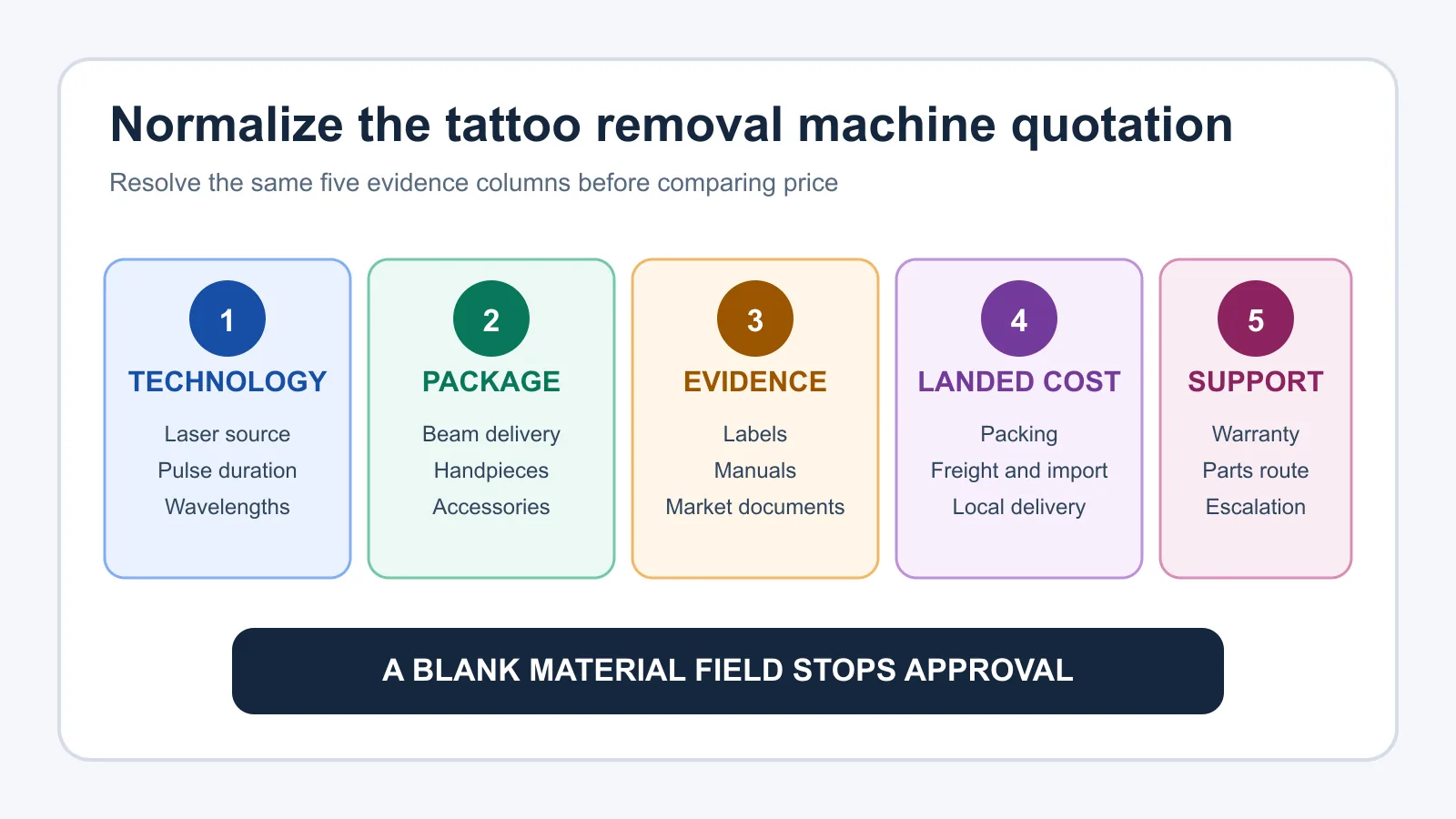
Tattoo removal machine cost depends on more than whether a listing uses the words picosecond or Q-switched. Buyers need to compare the exact laser source, pulse-duration category, wavelength package, beam delivery, handpieces, accessories, training, market documents, shipping terms, and support obligations. A price is useful only when those fields describe the same scope.
This guide gives clinics and distributors a quotation-normalization method. A defensible total requires a confirmed equipment configuration and commercial terms for the specific buyer, destination, and order.
Normalize each quotation before judging the price
Begin the tattoo removal machine cost comparison with a one-page record for every machine. Put the supplier's exact model name at the top, followed by the technology category, laser source, stated pulse width, wavelengths, spot sizes, included handpieces, accessories, operating language, electrical requirements, packing, training, documents, warranty scope, and service route. Mark every unconfirmed field as pending.
This prevents three common errors. First, buyers may compare a base-unit listing with a complete package. Second, a product family may contain several configurations even though the listing uses one name. Third, an optional wavelength or handpiece can be mistaken for a standard inclusion. Each error makes the tattoo removal machine price look more certain than it is.
Use one currency and one delivery basis when comparing totals. Keep taxes and recoverable taxes separate. Record the quotation date and validity period, because exchange rates, freight, options, and supplier terms can change. A normalized table creates an auditable purchasing record for a clinic and a repeatable sales record for a distributor.
Decide whether picosecond or Q-switched technology fits the plan
Technology category should come before brand preference. The U.S. Food and Drug Administration explains that different tattoo colors absorb different wavelengths and that laser tattoo removal should be performed by, or under the supervision of, a healthcare professional using an appropriate laser. The same FDA tattoo-removal guidance also notes that complete removal may not be possible. That makes wavelength coverage, intended professional use, and training more important than an unsupported promise of universal results.
Compare pulse-duration claims on the same basis
Picosecond and Q-switched systems are often presented as a simple new-versus-old choice. The purchasing question is narrower: what pulse-duration category and measured specification apply to the quoted mode and wavelength? Request the current specification rather than accepting a technology label by itself.
A systematic review indexed by PubMed found that the available picosecond tattoo-removal evidence was limited and heterogeneous, with many non-comparative studies and medium-to-high risk of bias. That evidence does not support assuming that every picosecond machine will outperform every nanosecond Q-switched system. Buyers still need to assess the exact device, its cleared or authorized use in the target market, operator training, and service plan.
Match wavelengths to the intended service scope
Wavelengths are not decorative additions to a quotation. Different ink colors absorb light differently, so the wavelength package affects which cases a qualified operator may consider within the device's intended use. Record standard and optional wavelengths separately, along with the handpiece or optical component used to deliver each one.
For a clinic, the planned service mix should guide the shortlist. For a distributor, the target customer's service mix and local rules should guide inventory. Do not pay for an option simply because it lengthens the specification sheet. Ask whether the option is included, how it is verified, what training it requires, and how it changes service and replacement-part needs.
A picosecond tattoo removal machine cost comparison should still begin with the exact quoted configuration, because a technology label alone does not define the included wavelengths, beam-delivery parts, accessories, training, or support.
Treat clinical claims as a separate evidence review
A supplier's equipment quotation should not double as a clinical protocol. Claims about clearance, session count, skin suitability, pain, downtime, or adverse effects need evidence that matches the device, indication, operator context, and market. Keep those claims out of the cost comparison unless the supplier provides the applicable authorization and evidence for review.
This separation protects the purchase decision. The commercial team can compare equipment scope and ownership cost without turning a model name into a treatment guarantee. The clinical or regulatory team can then review intended use, labeling, training, and patient-facing statements under the rules that apply in the destination market.
Check the beam-delivery package and replaceable parts
Once the technology category is clear, inspect what connects the laser source to the working tip. A complete quote should identify the articulated arm or other delivery path, treatment handpieces, optical tips, spot-size controls, footswitch, eyewear, calibration or test items, and any accessories shown in sales images. If an item is optional, its price and compatibility should appear separately.
Verify what is supplied
Ask the supplier to provide a packing list and labeled product photographs for the quoted configuration. Match each handpiece and accessory to the specification. Confirm whether the equipment can operate as quoted without buying another part immediately after arrival.
For DEPELITE, verified model-scoped reference values are 1064 nm and 532 nm, a 350 ps pulse-width value, 1-10 Hz, and a 2-10 mm spot-size range. Optional wavelengths, handpieces, energy ranges, and market documents should remain separate until the current quotation confirms them.
Price wear items and failure points
Ask which optical parts, lamps, rods, filters, water-system components, articulated-arm parts, tips, switches, screens, and cables are treated as consumables, wear items, or repair parts. The relevant list depends on the exact system. For each item, record whether it is user-replaceable, whether calibration or service is required, how it is ordered, and whether the supplier recommends holding a spare.
The answer affects both buyers. A clinic needs to know how a small part could interrupt appointments. A distributor needs to decide which parts to stock and which repairs can be supported locally. A low base price can create a high support burden if common replacement items are costly, slow to obtain, or difficult to install.
Compare training, documentation, and operator requirements
Define the training scope
Training is part of the acquisition, not an afterthought. Record whether training is live or recorded, remote or in person, and which languages and user roles it covers. Ask whether it addresses startup checks, safe handling, routine care, fault reporting, and the exact handpieces included with the order.
Check requirements in the destination market
Operator and facility requirements vary by country, state, province, and service type. The FDA's medical laser guidance classifies medical lasers as medical devices in the United States and notes that surgical laser products must comply with medical-device regulations. Buyers outside the United States need the relevant national and local authorities for their market. A supplier document or CE/FDA claim should not be generalized to every model or destination.
Distributors should request a document map before importing. It can list the manufacturer and product identity, model naming, labels, manuals, electrical and laser-safety documents, packaging marks, available test reports, and any market-specific files. The distributor's local regulatory adviser or importer of record should decide what is sufficient. Keep missing files visible as open purchasing conditions rather than assuming they will arrive later.
Put warranty, service, shipping, and customs into the landed cost
Warranty comparisons need component-level detail. Ask for coverage and exclusions for the laser source, articulated arm, handpieces, screen, power supply, cooling components, and other key parts. Record when coverage begins, who diagnoses a fault, who pays shipping, whether labor is included, and what happens when the issue cannot be solved remotely. Do not rely on a broad phrase such as “lifetime support” without the written scope.
Next, calculate landed cost. Add the configured machine, options, export packing, origin handling, main freight, insurance, destination handling, broker charges, duties, nonrecoverable taxes, inland delivery, installation, and initial training. Keep the agreed Incoterm and named place next to the freight figure so the purchasing team can see where responsibility changes.
For distributors, add sample or demonstration units, translated materials, spare stock, reseller training, local service tools, and support labor. These costs may sit outside the supplier invoice, but they belong in the product-line decision. The result is a realistic cost to launch and support the line, not merely a factory price.
Use a quotation comparison table
Use this tattoo removal machine quotation table for every shortlisted system. Require a document or written answer for each material field.
| Comparison field | Quotation A | Quotation B | Buyer decision |
|---|---|---|---|
| Exact model and technology category | Are the systems genuinely comparable? | ||
| Pulse-width specification and applicable mode | Is the number tied to the quoted configuration? | ||
| Standard and optional wavelengths | Does the package fit the intended service scope? | ||
| Beam delivery, handpieces, and spot sizes | Are all working components included? | ||
| Accessories and safety items | What must be bought separately? | ||
| Training format and language | Can the intended team use the supplied program? | ||
| Documents for the destination market | Which files remain subject to local review? | ||
| Warranty scope and exclusions | Which parts, labor, and shipping responsibilities are covered? | ||
| Remote diagnostics and repair route | How will downtime be managed? | ||
| Packing, freight, customs, and local delivery | What is the landed cost on one basis? | ||
| First-year parts and support allowance | What ownership cost sits outside the invoice? |
Do not award a supplier a blank field. Treat missing information as unresolved and ask for it before signing the purchase order. If the suppliers use different names for similar items, attach their source documents to the comparison so the final decision does not erase those differences.
Red flags in low-price listings
A low price is not a problem by itself. The concern is a low price combined with an unclear scope. Pause the comparison when a listing omits the exact model, source type, pulse width, standard wavelengths, included handpieces, packing list, electrical requirements, or supplier identity. Generic product photographs and copied specification tables also need verification.
Be cautious when a seller promises the same result for every tattoo color, skin type, operator, or treatment plan. The FDA notes that tattoo colors respond differently to wavelengths and that removal outcomes vary. A purchasing claim that ignores those limits should not be used to forecast clinic results or justify a higher equipment budget.
Commercial gaps matter too. A price that excludes export packing, uses an unclear delivery term, or leaves return-shipping responsibility undefined can move substantial work to the buyer. An unspecified warranty, no named technical contact, or no parts-ordering process can make even a functioning machine difficult to support.
Review a verified MQLASER configuration
MQLASER's picosecond and Q-switch laser product line gives professional buyers a starting point for a configuration discussion. DEPELITE's verified reference configuration should be compared with the current quotation, supplied handpieces, document set, and destination-market requirements rather than treated as a universal package.
Send your completed comparison table, country, buyer type, intended professional service category, expected workload, required wavelengths, training needs, and documentation questions when you request a model-specific quotation. Ask the sales team to identify standard items, options, exclusions, and open points in writing.
Use the matrix's unresolved column as a stop rule. Do not approve the order while a material technology, inclusion, document, or service field is blank. Once every field has evidence, any remaining tattoo removal machine cost difference has an identifiable cause that the purchasing team can accept, negotiate, or reject.
FAQ
Q: Can two tattoo removal machines with the same wavelengths justify different prices?
A: Yes. Shared wavelength labels do not make the laser source, pulse duration, beam delivery, optics, handpieces, control system, included accessories, documentation, or support equivalent. The price difference is defensible only when the quotation identifies those differences and they matter to the buyer's intended use.
Q: What should an importer do if the model name differs across the invoice, label, and documents?
A: Pause the order and ask the supplier to reconcile the names in writing. Product identity should remain consistent across the quotation, specification, labeling, packing list, manuals, and market documents so the importer can determine which device is actually being supplied.
Q: Do operators need a license or qualification to use a laser tattoo removal machine?
A: Requirements depend on the country and may also vary by state, province, facility type, and professional scope. Confirm the rules with the relevant regulator and qualified local adviser before purchasing, importing, advertising, or operating the equipment.
Q: Are home tattoo removal machines a substitute for professional laser equipment?
A: No consumer listing should be treated as a substitute for a professional device and trained oversight. The FDA states that it has not approved do-it-yourself tattoo removal kits and that cleared tattoo-removal lasers are for use by, or under the supervision of, a healthcare professional.
Q: Can a clinic calculate profitability from the machine price alone?
A: No. A useful model also needs local service pricing, realistic appointment capacity, staffing, room cost, supplies, marketing, downtime, financing, taxes, and demand. Use conservative business assumptions and keep treatment outcomes separate from the financial forecast.