Aesthetic Clinic Equipment List: A Practical Buyer Guide
Most buying mistakes begin before anyone compares machines. An aesthetic clinic equipment list may look complete while overlooking the operator, the room, or the rules in the destination market. Length is not the test. Each line needs a clear reason to be there: it must support a service the clinic is ready to offer.
That changes the order of work. Begin with the service menu and the limits of the site, then decide which equipment families deserve a closer look. Model documents and quotations are useful once the shortlist is real, not while it is still a collection of possibilities. This guide gives clinic owners, purchasing managers, salon groups, practice planners, and distributors a practical way to make that shortlist.
Start with the service plan, not the equipment catalogue
Start with a blank page, not a supplier catalogue. Write down the services planned for opening and place later ideas in a separate column. Beside them, note the expected workload, the people who may operate the equipment, the rooms available, and the destination market. Finally, name the decision makers for clinical scope, site changes, training, and purchasing.
For a group with several locations, the format can be shared; the answers should not be. A branch with a different room or staffing plan may need a different shortlist even when the public service menu is similar. Separate briefs keep those differences visible while still giving the purchasing team a common basis for comparison.
The value of the brief becomes obvious when an attractive feature has no operational home. Perhaps there is no qualified role assigned to the service, or the only available room has not been checked. In that case, the category is not launch-ready. Suppliers also receive a clearer request because they are responding to one defined plan rather than an open-ended search for equipment.
Ask five questions for each proposed service:
- Is this service part of the approved launch scope in the destination market?
- Who will operate it, and who will supervise where required?
- Which room, safety, cleaning, and record controls apply?
- How much work is the system expected to handle?
- What must the approval team read before committing to the purchase?
An unanswered question is a reason to pause, not a blank to fill with a guess. Leave the category outside the launch column until its owner can close the issue.
Prepare the treatment room and operating system first
An empty room is not necessarily a suitable room. Check it against the system being quoted rather than borrowing requirements from another machine. Electrical supply, cooling, ventilation, access, protective equipment, and signs may not carry over. The supplier provides the installation information; the relevant local professionals decide whether the site can satisfy it.
There is an operating system to design as well. Where will the instructions live? Who records training and maintenance? Who can restrict access or take the equipment out of service after a fault? Cleaning, incident records, and routine ownership are easy to treat as small details, yet they determine whether the setup remains controlled after installation.
Keep two signatures in mind. One confirms what the manufacturer requires. The other confirms how the clinic will meet that requirement at its site. Facility, electrical, safety, and clinical owners may all have a role in the second decision. A product document on its own is not a room approval.
The regulatory check is market-specific. In the United States, the FDA guidance for radiation-emitting products describes product-specific manufacturer, reporting, recordkeeping, and medical-device obligations that can apply to laser and other radiation-emitting medical products. A historical OSHA laser safety directive can inform planning for hazard evaluation, controls, training, signs, and protective equipment. These are US references, not approval for every market or every model. Local rules and the quoted device instructions still govern the destination check.
Map the core energy-based equipment categories
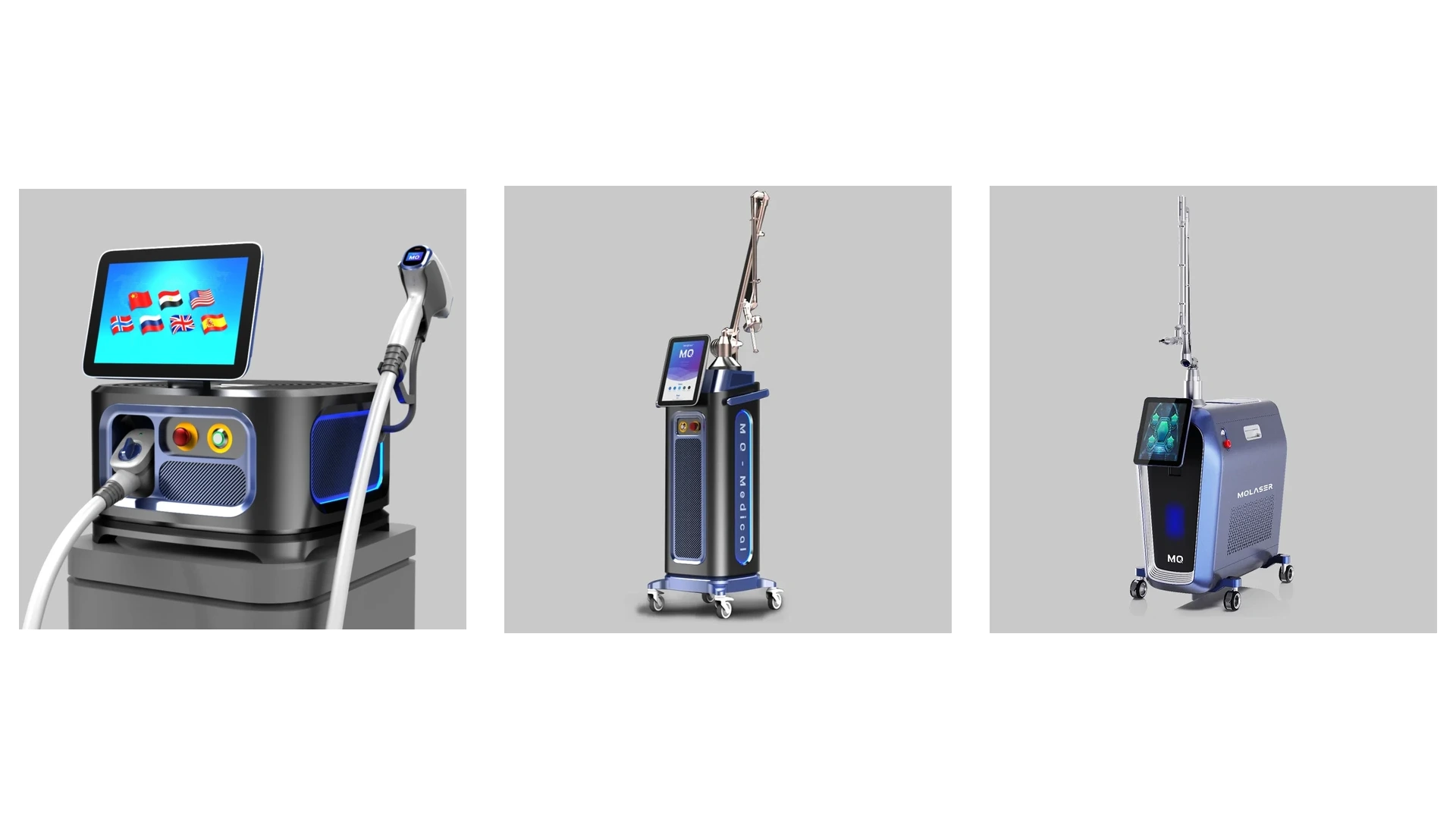
MQLASER currently organizes its professional catalogue around three equipment families. That is a useful map, provided the team does not confuse a family with a finished purchase specification. Configuration, included accessories, documents, training, and support still belong to the individual quotation.
Put the family name on the main shortlist and indent candidate models beneath it. The team can then settle the larger question—whether the category fits the service plan—before comparing feature lists. It also gives every quotation a separate place, so an accessory or service promise from one offer does not quietly migrate into another.
Diode laser hair removal systems
Diode laser hair removal systems enter the discussion when professional hair-removal services are approved for the clinic. The next questions belong to the quotation: included handpieces, accessories, site inputs, training, documents, and the route for service questions. Keep every answer attached to its model. A category label is too broad to support a model-level assumption.
Fractional CO2 laser systems
Fractional CO2 laser systems are a separate family. The planned service must fit the available qualifications, room controls, and local requirements before this category moves forward. For a shortlisted system, record the model and operating configuration along with the supplier's training, maintenance, and support information. General category language cannot be used as a treatment protocol or a promise of results.
Picosecond and Q-switch laser systems
Picosecond and Q-switch laser systems may fit a plan that calls for professional pigment- or tattoo-removal equipment. The buying team can verify the quoted platform, configuration, site conditions, components, documents, training route, and service path. It cannot make the clinical decision through procurement. That assessment remains with the responsible qualified professionals working under local rules.
Build a phased aesthetic clinic equipment list
A phased aesthetic clinic equipment list should answer a blunt question: what must be ready on opening day, and what can wait? The answer comes from the service brief and the evidence already collected. It cannot be copied from a universal launch formula.
| Purchase phase | Equipment and supporting items | Approval rule |
|---|---|---|
| Launch critical | Systems for approved opening services; treatment furniture; manufacturer-specified room connections; access and protective controls; cleaning, storage, documentation, and record tools | Move to quotation only when service scope, operator, room, training, local requirements, and supplier evidence are all clear |
| Expansion | A further equipment family, additional capacity, optional handpieces, photography or consultation tools, or workflow upgrades tied to a defined need | Keep in the next budget with a named owner, intended site, workload, training path, and purchase trigger |
| Optional or deferred | Duplicate capability, accessories without a defined use, or a platform with unresolved staffing, room, documentation, or market questions | Hold, reject, or seek evidence until the item can pass the same tests as launch equipment |
Four status labels are enough for launch items: evidence received, owner confirmed, approval pending, and approved. Each label should link to the document behind it. Otherwise a confident-sounding spreadsheet entry can hide the fact that the team is still waiting for a supplier reply, an internal decision, or a site change.
Do not let the main machine push smaller requirements out of view. A couch, trolley, secure storage, documentation camera, protective equipment, cleaning supplies, or maintenance record may be relevant, depending on the device and service. Give those items owners and sources too.
Expansion is where uncontrolled lists tend to grow. A deferred item needs a trigger that people can recognize later, such as approval of a new service, a real capacity constraint, completed training, or a validated room. Without one, there is no sound way to tell future need from present enthusiasm.
Compare platforms with one supplier evidence sheet
Once the shortlist is stable, comparison should become deliberately repetitive: the same questions, asked of every supplier, with each answer filed beside the quote. MQLASER's professional aesthetic laser equipment catalogue points buyers toward configuration, training, documentation, and support. The sheet below gives those checks a consistent home.
| Evidence field | What to obtain in writing |
|---|---|
| Product identity | Model name, quoted configuration, software or language options, and a quotation date or reference |
| Included scope | Main unit, handpieces, accessories, consumables, spare items, and anything pictured in marketing but excluded from the offer |
| Intended buyer use | Professional service category presented for the system, without treating that description as a clinical-results promise |
| Site requirements | Electrical, environmental, installation, access, and storage needs stated by the manufacturer for this configuration |
| Training and documents | Training format, operator material, installation information, instructions, maintenance guidance, and destination-market documents included |
| Service route | Contact channel, troubleshooting process, maintenance ownership, spare-parts route, and escalation path |
| Commercial boundaries | Validity of price, payment terms, shipment scope, delivery estimate, warranty terms, exclusions, and buyer duties |
If a supplier has not answered a field, leave it open. Add an owner and a next action, but not an invented conclusion. The blank then does useful work: it shows an approver where to stop.
File the sheet by model, configuration, and quotation date. When a revised quote changes any of those details, reopen the related checks. A familiar product name is not evidence that an old answer still applies.
Turn the list into a purchase and validation plan
The shortlist is ready to become an approval record when another person can follow the decision without reconstructing it from email. Before ordering:
- Freeze the launch service brief and assign clinical scope, site readiness, safety, training, finance, and supplier communication.
- Close room and operating gaps against the device instructions and applicable local requirements.
- Review every quote through the same evidence fields, without mixing models or configurations.
- List each open question, the person handling it, and the proof needed to close it.
- Approve only equipment with a defined service role, prepared site, qualified operating route, and clear commercial scope.
- Keep the final quote, written confirmations, supplied documents, training record, and acceptance checks in one file.
This record follows the equipment into installation and explains why each line was approved, deferred, or rejected. That is useful to the clinic team and to any distributor coordinating the order.
End with a brief closeout meeting. Owners should bring evidence for their open items and check revised quotations again. They should also ask whether a room or configuration change has made an earlier answer stale. The final entry is simple: the decision date and the exact quotation version approved.
Conclusion
A practical aesthetic clinic equipment list is a record of choices, not a catalogue extract. It shows which services come first, which room and operating questions are closed, and why a particular equipment family belongs in the launch plan. Later options stay visible without being mistaken for opening requirements.
For the inquiry, send the service categories, destination market, room constraints, and document needs with the shortlist. Request a product quotation to verify the current MQLASER configuration, included scope, training route, documents, support path, and commercial terms in writing.
FAQ
Q: What equipment do you need to open an aesthetic clinic?
A: Begin with the approved launch services and work outward. Add the systems those services need, followed by the relevant room, safety, cleaning, storage, documentation, and record tools. The final mix will depend on operator qualifications, workload, site conditions, device instructions, and the destination market.
Q: Should a clinic buy every equipment category at launch?
A: No. Keep a category in the launch phase only when it supports an approved service and has a qualified operating route, suitable room, training plan, and enough supplier evidence for a decision. Give every later category a specific trigger instead of buying it “for the future.”
Q: What should be confirmed before requesting an aesthetic laser quotation?
A: Be ready to state the service category, destination market, expected workload, operator role, available room, and required documents. Ask the supplier to identify the model and configuration, included components, site needs, training, maintenance, support, warranty boundaries, shipment scope, and commercial terms.
Q: Can one laser platform cover every planned aesthetic service?
A: Do not assume so. Map the services first, then assess the proposed platform with qualified professionals and written supplier information. Different services may require different technologies, room controls, operator preparation, documents, or local-market checks.